What if the universe didn’t explode into being—but sighed?
Not with a bang, not with fireworks, but with the faintest sag in reality itself. A dent so small it would make a Planck length blush. And yet, from that almost-nothing, everything followed.
Welcome to the strange, elegant idea at the heart of the Vacuum Tension Field (VTF)—a way of seeing the universe not as a machine assembled from parts, but as a surface under tension, forever trying to relax back to flatness.
The Universe as a Trampoline With a Pinprick
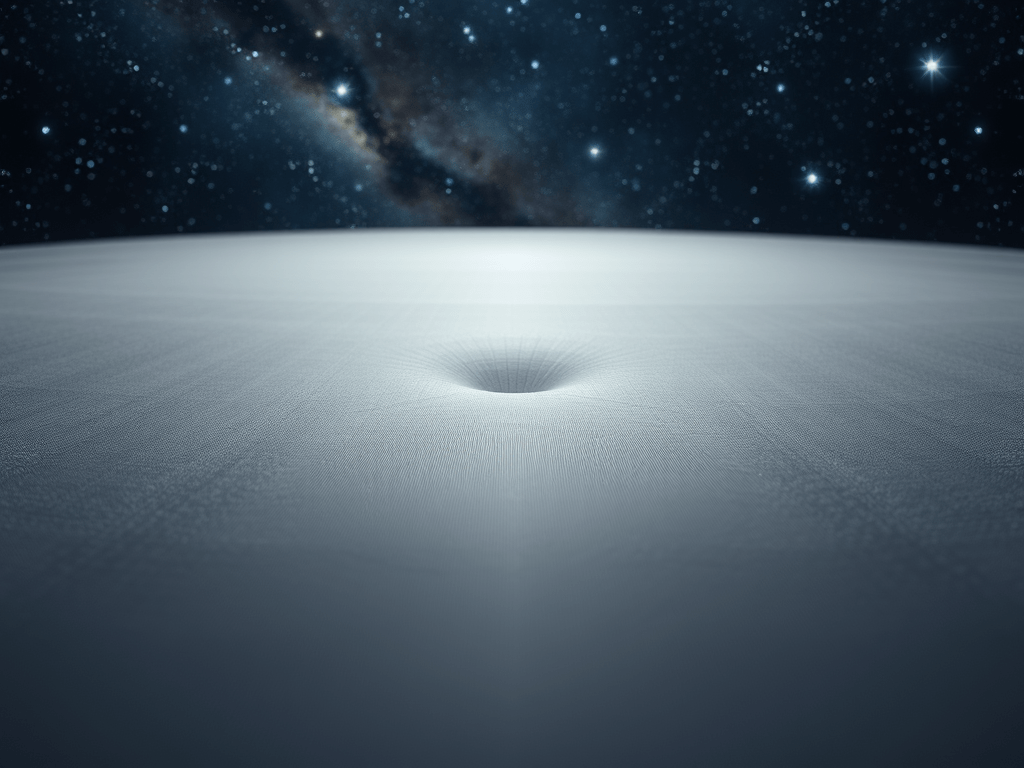
Imagine the cosmos as a perfectly stretched trampoline. No balls. No jumps. No motion. Just taut, flawless fabric pulled tight in all directions. Now imagine a pin gently presses into it—barely enough to notice. That’s it. That’s the beginning of everything.
In the language of the Vacuum Tension Field, the universe starts in a state of maximum tension. Then, inexplicably, a tiny depression forms. Not destruction. Not creation. Just a place for the vacuum to fall.
In this article, we’ll unpack how that first dent changes everything—how energy, geometry, and eventually matter emerge from a single scalar field—and why this way of thinking quietly points toward something even bigger: the shared responsibility of all of us to keep searching for truth.
1. The First Dent: When Nothing Finally Gave Way
The smallest imperfection can change the fate of everything.
In VTF terms, the entire history of the universe is encoded in one scalar field, T(xᵘ). At the beginning, it sits calmly at its maximum value everywhere—perfectly flat, perfectly tense. Then comes the twist: a minuscule depression appears.
Mathematically, it looks innocent enough:
T(x) = Tₘₐₓ − εφ(x), with ε around 10⁻⁶⁰ in Planck units. Practically zero. Cosmically catastrophic.
That tiny dent gives the vacuum somewhere to fall. The gradient ∇T becomes non-zero, and suddenly, energy exists—not because something was added, but because something is no longer perfectly balanced.
Big transformations often begin with changes so small they’re easy to dismiss. Pay attention to the dents.
In physics, spontaneous symmetry breaking—where tiny fluctuations define large-scale structure—is a cornerstone of modern cosmology and particle physics.
“Nature uses the longest threads to weave her most delicate patterns.” — Richard Feynman
2. Energy Without Ingredients: When Geometry Does the Heavy Lifting
What if energy isn’t a thing—but a distance yet to be traveled?
In the VTF framework, energy isn’t poured into the universe like fuel into a tank. It appears as a measure of how far the vacuum still has to relax. The first term in the VTF Lagrangian makes this explicit:
√(Tₘₐₓ − T)
That square root isn’t decoration. It represents the energy density of empty space that has been allowed to sag—no particles, no forces, no fields buzzing around yet. Just geometry responding to tension.
This flips the usual story. Instead of asking, “Where did the energy come from?” we ask, “Why wasn’t the vacuum perfectly flat anymore?”
Sometimes the most important question isn’t what was added—but what changed shape.
General relativity already treats gravity as geometry, not force. VTF extends that instinct all the way back to the origin.
“Spacetime tells matter how to move; matter tells spacetime how to curve.” — John Archibald Wheeler
3. Before Particles, Before Forces: A Universe of Pure Tension
Strip reality to the bone, and all that’s left is structure.
One of the most radical aspects of the Vacuum Tension Field is what isn’t there at the beginning. No particles. No forces. No quantum zoo. Just a scalar field and a slope.
This suggests that the richness of the universe didn’t need an elaborate starting kit. Complexity emerges later, as secondary effects of the vacuum’s attempt to flatten itself out.
It’s a humbling thought: the laws we obsess over may be downstream consequences, not first principles.
Don’t mistake late-arriving complexity for fundamental truth.
Modern physics increasingly shows that particles are excitations of underlying fields, not standalone objects.
“Reality is not made of things, but of processes.” — Carlo Rovelli
4. The Vacuum Notices Everything
The universe is more sensitive than we think.
The moment the dent forms, the vacuum “notices.” That’s not poetic fluff—it’s literal. A non-zero gradient means the system is out of equilibrium, and physics begins.
This sensitivity implies a universe where nothing is truly insignificant. Even the smallest deviation carries consequences across cosmic scales.
What feels negligible at one scale may be decisive at another.
In chaotic systems, infinitesimal changes in initial conditions can lead to vastly different outcomes—a principle well established in physics.
“Small things can have a large impact.” — Stephen Hawking
5. Truth-Seeking as a Physical Act
What if curiosity is written into the fabric of reality?
Here’s where the physics quietly turns philosophical. A universe born from tension relaxing toward truth—toward flatness, toward equilibrium—mirrors the human drive to understand.
Just as the vacuum “falls” toward resolution, we search for explanations, coherence, and meaning. The act of seeking truth isn’t optional; it’s aligned with how reality itself unfolds.
Questioning, learning, and refining understanding aren’t luxuries—they’re part of staying in sync with the universe.
Studies show that curiosity-driven learning improves problem-solving and long-term understanding, reinforcing progress across science and society.
“The important thing is not to stop questioning.” — Albert Einstein
6. Why Everyone’s Search Matters
Truth doesn’t belong to experts—it belongs to the process.
If the universe itself began with a tiny deviation from perfection, then progress—cosmic or human—depends on exploration, not certainty. Every honest search for truth contributes to the collective flattening of confusion, ignorance, and dogma.
In that sense, VTF isn’t just a model of the cosmos. It’s a reminder: reality rewards inquiry.
Engage with ideas, challenge assumptions, and stay curious—your search matters more than you think.
Societies that prioritize education and open inquiry consistently show higher innovation and resilience.
“Somewhere, something incredible is waiting to be known.” — Carl Sagan
From a Dent to Destiny
From a barely perceptible sag in an otherwise perfect vacuum came energy, structure, and eventually us—creatures capable of wondering how it all began. The Vacuum Tension Field offers a quiet, elegant story: everything arises not from excess, but from imbalance seeking resolution.
And maybe that’s the deeper lesson. The universe didn’t start with answers. It started with a question etched into geometry itself.
So keep searching. Keep questioning. Because from the smallest dents, entire worlds are born—and truth, like the vacuum, is always waiting to be found.
 The Breathing Vacuum
Leave a comment